
Material intelligence / Field guide
Architectural Wall Panel Materials: A Guide to Five Decorative Surface Types
A designer’s guide to construction, visual character and the checks that turn a finish sample into a workable specification.
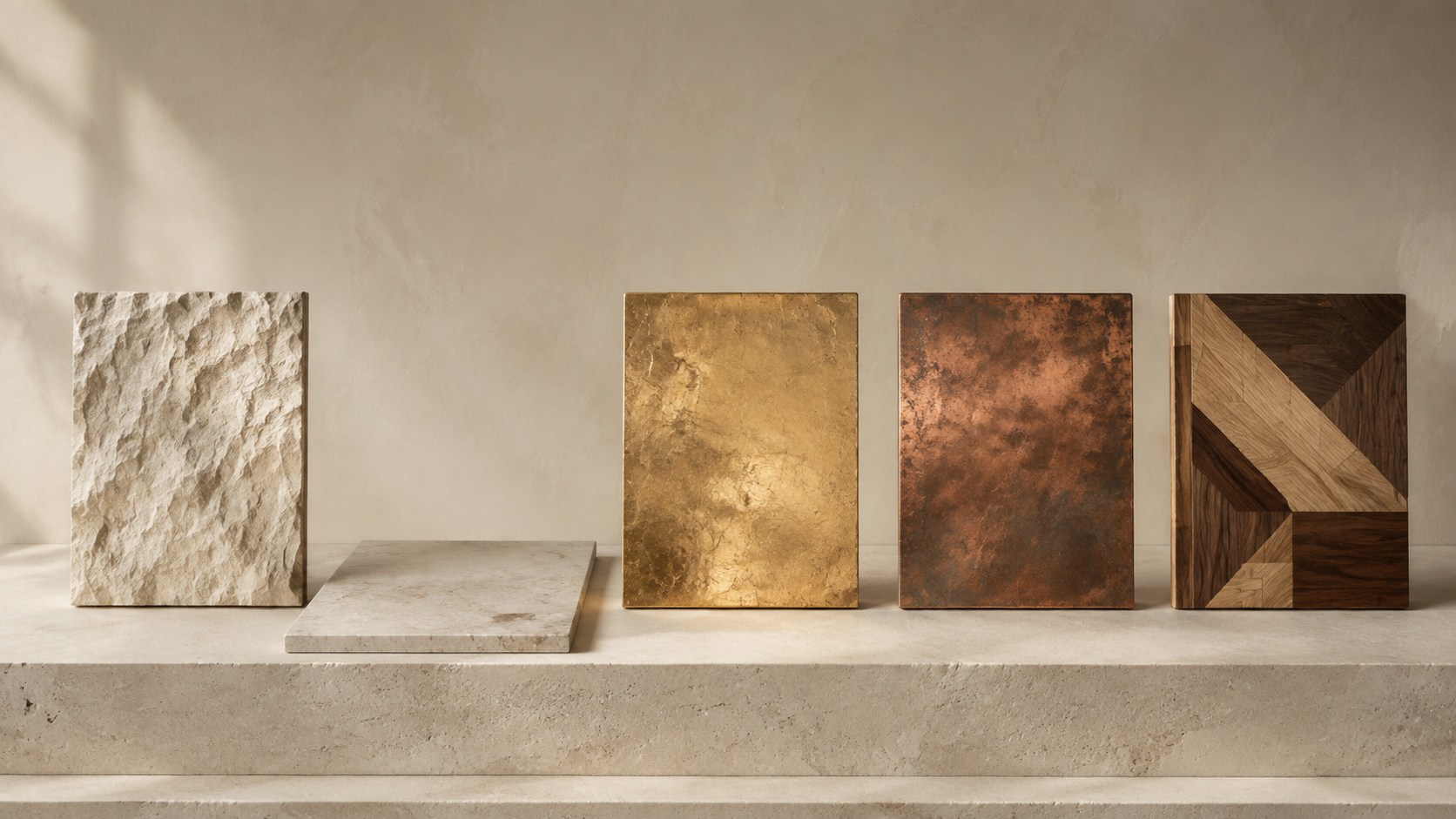
A wall sample can be convincing in the studio and still leave the important project questions unanswered. Will its relief read from the entrance? Can the pattern continue around a return? What happens where the finish meets a door frame? Architectural wall panel materials become easier to select when their construction is considered alongside their appearance.
This guide introduces five decorative surface families in the Versa collection: PU Stone, Flexible Stone, Art Gilded, Metallic-Finish and Marquetry. They offer different ways to create depth, mineral character, reflection and pattern. None is a universal substitute for the others.
At a glance
Choose a wall panel by identifying its material construction, the visual effect required and the conditions of the intended installation. A photograph establishes a direction; a representative sample and coordinated wall detail establish whether that direction is workable.
- For dimensional stone-like relief: investigate molded PU Stone, then assess repeat, exposed edges and the fixing system.
- For thin mineral surfaces or curves: identify which Flexible Stone construction is being offered before reviewing geometry.
- For reflective or composed surfaces: distinguish leaf gilding, metallic-effect finishes and physically assembled marquetry.
What are the five decorative surface types?
PU Stone: molded volume and stone-like relief
PU Stone panels use a rigid polyurethane body with a molded surface and decorative finish. The depth comes from the panel's shaped geometry; the stone-like color comes from its surface treatment. The term describes a decorative polymer panel, not a piece of quarried stone.
The useful design question is how the relief works at wall scale. Inspect several panels together: a distinctive ridge that looks attractive on one sample may become an obvious repeat across a reception backdrop. Check side views, cut edges and corners as carefully as the front. Explore the PU Stone collection for visual directions, then request the construction and dimensions of the selected model.
Flexible Stone: first identify the material route
Flexible Stone is a market description covering more than one construction. MCM-type products form a mineral-based composite surface; natural flexible stone veneer carries a thin real-stone face on a supporting backing. A product called “travertine” might describe an appearance rather than quarried travertine.
Both the face and the backing matter when assessing a curve. A successful bend on a loose sample does not establish an installed radius or adhesive specification. The Flexible Stone guide explains the distinction in detail. As an external example of the natural-stone route, Slate-Lite describes a real-stone surface with fiberglass reinforcement; that description is not a specification for Versa products.

Art Gilded: a thin metal leaf on a prepared surface
Art Gilded panels use applied metal leaf and artistic finishing over a prepared substrate. Leaf edges, overlaps and local variation contribute to the reflective character. The support board and protective finish remain important parts of the construction.
A gold-colored surface does not establish that the leaf is gold. Ask for the leaf material, finish system and approved variation range. Review it under the proposed lighting, particularly where guests may touch the surface. The Art Gilded collection is a starting point for finish discussion, rather than evidence of a particular metal content or performance classification.
Metallic-Finish: an appearance with several possible constructions
A copper, bronze or patina appearance may come from metallic pigments, a reactive finish, a metal-containing composite, a continuous metal face or a printed effect. Those routes need different descriptions and may require different maintenance.
Ask what creates the visible effect and what sits beneath it. A metallic pigment coating can change appearance with light and viewing direction; a printed patina communicates a pattern without necessarily undergoing oxidation. The Metallic-Finish collection should therefore be reviewed by finish route as well as color name. Research on metallic-coating reflectance and flake orientation explains why pigment alignment can affect appearance; it does not establish the performance of an entire wall panel.
Marquetry: a composition made from assembled pieces
Marquetry creates a pattern by cutting and assembling veneer or other thin decorative pieces onto a support. In a wood-veneer composition, grain direction is part of the pattern. It is different from printing a picture of joined pieces onto a continuous surface.
A small sample can establish workmanship and color, but cannot settle a large composition. Review the complete elevation, panel sequence and where the pattern stops at openings. The Marquetry collection offers a visual starting point. For historical evidence of the cutting-and-assembly principle, see Getty's technical examination of a marquetry commode; a furniture example does not establish wall-panel performance.
How does the material change the room?
Read the wall at three distances. From the entrance, assess proportion and overall tonal movement. At normal circulation distance, review repeated shapes, panel divisions and reflected light. At arm's length, inspect surface texture, joins and exposed edges.
Then repeat the review under the intended lighting. Grazing light can make both relief and irregular joints more prominent. A metallic finish can look quiet from one position and strongly reflective from another. A marquetry pattern may appear continuous in diffuse light but reveal changes in grain direction as the observer moves.

These are reasons to specify observation conditions, not to demand identical appearance from every angle. Record the main viewpoints, lighting arrangement and acceptable variation with the approved sample. Where possible, use a full-size panel or assembled mock-up at the intended wall location.
Which constraints should rule out a material early?
Start with exposure, substrate, fixing requirements and maintenance. A highly touched retail wall presents different questions from a protected hotel backdrop. A curved column introduces different detailing from a flat wall with generous edge trims.
Do not infer acoustic performance from a textured face, fire performance from a metallic appearance, or environmental performance from the word “natural.” These are separate questions requiring applicable evidence. For moisture exposure, consider the complete wall: the facing, adhesive, joints, penetrations and underlying waterproofing strategy where required.

Write unresolved requirements into the sample request. It is more useful to ask whether a specific assembly is supported for the proposed application than to ask whether an entire product family is “waterproof” or “fireproof.” The selected model and installation arrangement must match the documents being reviewed.
A material selection matrix for the first shortlist
| Primary design aim | Material route to investigate | Confirm before selection |
|---|---|---|
| Deep stone-like relief | PU Stone | Repeat, returns, finished edges and fixing |
| Thin mineral expression or a curved surface | Flexible Stone | Material identity, backing, tested geometry and adhesive |
| Leaf-like reflection and hand-finished variation | Art Gilded | Leaf identity, variation range and surface care |
| Controlled metallic or patina appearance | Metallic-Finish | Effect-producing layer, direction and protection |
| Composed grain and geometric pattern | Marquetry | Veneer identity, elevation, sequence and edge details |
This matrix establishes a shortlist, not final approval. Two products within the same family can differ in substrate, thickness, protective finish and documented application. Budget comparisons should include preparation, trims, installation, packing and spare material rather than only the panel price.
What should an approval sample include?
Ask for a face sample and a representative edge or cross-section. For repeated or directional finishes, request enough pieces to judge a sequence. For curves and corners, include the relevant detail in the mock-up instead of reviewing a flat sample alone.

A useful approval record identifies the product code, finish version, substrate, viewing conditions, accepted variation and unresolved technical checks. Keep a reference sample for comparison with delivered material. This gives the designer, supplier and installer a shared basis for decisions when lighting, batches or site conditions change.
Questions designers often ask
Are decorative wall panels structural?
Do not assume they are. Specify the support and attachments independently unless the exact panel system has documented structural functionality for the application.
Can several surface families be used on one wall?
Yes, as a design proposal, but coordinate total build-up, interfaces, movement, cleaning and replacement. A coordinated visual palette does not make the materials technically interchangeable.
Should the lowest-weight material always be selected?
No. Weight is one constraint alongside appearance, touch, impact exposure, maintenance and installation. Compare the proposed assemblies rather than selecting solely by material label.
Bring the wall brief into the sample discussion
Share the wall elevation, application, approximate dimensions, visual reference and any performance requirements with Versa. We can use that context to discuss which material samples will answer the most important design questions.
Continue with PU Stone vs Natural Stone or MCM and natural flexible stone veneer.
Considering this surface for your project?
Tell us about your space, desired finish and project requirements. Let’s discuss material options, samples and detailing.
Discuss Your Project Request Samples