
Material intelligence / Field guide
What Is Flexible Stone? MCM and Natural Stone Veneer Explained
Identify the material behind the name, then assess backing, geometry and installation requirements for your wall.
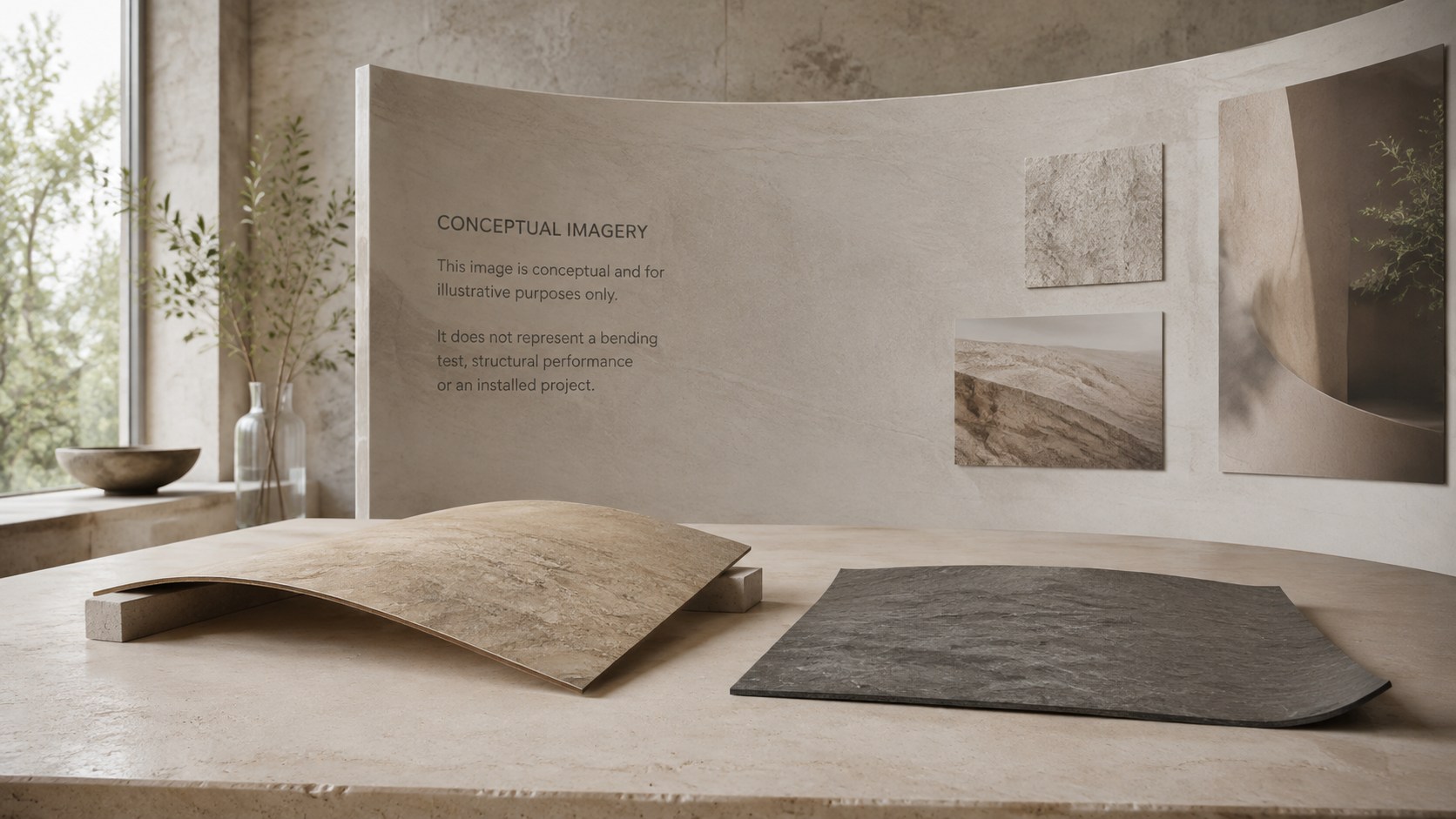
A designer asks for flexible stone for a curved reception wall. Two suppliers respond with convincing samples, yet the samples may be fundamentally different materials. One can be a formed mineral composite. The other can have a thin face of real natural stone bonded to a supporting backing.
Before discussing color or bend radius, establish which construction is being proposed. The phrase “flexible stone” describes a product category in the market; it does not reliably identify the surface composition, backing, installation system or permitted use.
At a glance
Flexible stone commonly refers to either an MCM-type mineral composite facing or a thin natural-stone veneer with a supporting backing. The first forms a mineral-based surface; the second retains an actual stone face. Flexibility belongs to the complete product and has limits that must be checked for the chosen model and geometry.
- Ask what the visible face is made from: formed mineral composite or a real-stone layer.
- Identify the backing: it affects handling, bonding and bending behavior.
- Approve the intended curve as an assembly: a loose hand-bent sample is not an installation test.
What is MCM flexible stone?
MCM is commonly expanded as Modified Clay Material. In this product route, mineral ingredients are processed with a binder system and formed into a thin decorative facing. Composition and manufacturing details vary; the name is not a universal recipe or a fixed proportion of stone powder, clay and polymer.
Surface profiles can interpret stone, earth, concrete, timber or other textures. Consequently, “travertine,” “slate” or “wood grain” in a collection may be the design name. Do not treat that name as a declaration that the face is quarried travertine, split slate or wood veneer.
PHOMI's product catalogue describes its modified-clay technology, providing a manufacturer example of this route. Its terminology and product claims should not be transferred automatically to another manufacturer's facing. For a specification, obtain the selected product's own composition description and technical documents.

For designers, the opportunity is a formed surface with its own texture, color and profile options. The review should examine the real sample, including edge, reverse and complete panel. Ask whether a reinforcing layer is present, what surface protection is supplied and how the finished thickness is defined.
What is natural flexible stone veneer?
Natural flexible stone veneer combines a thin layer of actual stone with a supporting backing. In a common route, the stone face is taken from a suitable layered stone and retained with a resin-based, reinforced support. The surface is genuine stone, but the finished sheet is a composite rather than a solid slab through its full thickness.
Slate-Lite describes its own construction as a natural-stone surface with fiberglass reinforcement. The manufacturer's product data sheet also distinguishes products rather than assigning one specification to every stone face. This is useful evidence for the category distinction, not a current performance certificate for a Versa product.
A real stone face can bring geological variation to a wall. It also requires a deliberate sample and layout process. Ask to see a representative range rather than expecting every delivered sheet to reproduce the first sample. Large-format approval should address tonal grouping, direction and the sequence of sheets.
The backing may influence the sheet's stiffness, bond compatibility and visible edge. Ask for a product cross-section and identification of any factory-applied treatment. “Real stone surface” does not mean that the complete panel, adhesive and substrate share the properties of unbacked stone.
MCM and natural stone veneer: what should the specification distinguish?
| Question | MCM-type facing | Natural flexible stone veneer |
|---|---|---|
| What is the face? | Formed mineral-based composite | Thin layer of actual natural stone |
| Where does the texture come from? | Forming and finishing process | Stone structure and production process |
| What does a collection name mean? | May describe an appearance | Confirm actual stone identity |
| What variation should be reviewed? | Production and finish range | Stone variation plus processing range |
| What determines bending? | Complete formulation, thickness and reinforcement | Stone face, backing and complete thickness |
| What confirms suitability? | Model-specific documents and assembly review | Model-specific documents and assembly review |
This distinction belongs in the product description, not just in a supplier conversation. A clearer specification might read “mineral-composite flexible facing, approved model and backing” or “natural slate-faced reinforced veneer, approved model.” Follow it with actual dimensions, finish and installation requirements once confirmed.

Neither material name settles the selection. Compare the visual intention, substrate, geometry, exposure and maintenance requirements. For broader alternatives, our five-material wall panel guide places flexible surfaces alongside molded relief, gilded finishes, metallic effects and marquetry.
What does “flexible” mean on a curved wall?
A sheet can bend without being suitable for every curve. The minimum usable radius depends on the exact product and conditions; one generic figure cannot cover all flexible stone products. Convex and concave applications can also present different contact and edge behavior.
Obtain the supplier's guidance for the intended radius and direction of bending, then test the actual assembly. Use the proposed substrate shape, panel orientation, adhesive and finishing details. Inspect the face for visible distress and the edges for lifting or loss of contact after the required curing period.

A broad curved column and a sharp outside corner are different details. Do not force a product around a tight return merely because a sales sample can be flexed by hand. A joint, separate return or trim may offer a more reliable and visually controlled solution.
Continuity matters as well. Decide where joints fall relative to the curve, viewing direction and lighting. If the texture has a strong direction, confirm how it reads as the face turns. Use an elevation and a small mock-up together; neither alone answers both appearance and installation questions.
Which installation assumptions cause problems?
Thin facing does not correct an unsuitable substrate. Establish the required flatness, surface soundness, moisture condition and cleanliness before selecting the bonding method. A surface that looks acceptable before installation may reveal irregularities under grazing light once a thin finish is applied.
Do not assume one adhesive is compatible with every backing. Request a recommendation for the specific panel and substrate, with application and curing conditions. Follow it with a representative bond trial where the project warrants one. Adhesive coverage, interface preparation and edge restraint should follow the selected system's instructions, not a generic social-media demonstration.
Likewise, flexible facing does not replace waterproofing or bridge building movement joints by default. For wet areas or exterior use, assess the whole construction and exposure. For regulated locations, review applicable performance documentation with the project team. Another supplier's certificate is not evidence for the model being installed.
A sample request that resolves material identity
Send the supplier the proposed wall geometry, approximate dimensions, setting, finish reference and any performance requirements. Request the following before final approval:
- The material route and selected product code, including the actual face and backing description.
- A face sample, a representative edge and enough variation samples to judge appearance.
- Confirmed dimensions and mass per area for that product, not a category average.
- Bending guidance relevant to the intended geometry, with a proposed mock-up method.
- Substrate and adhesive requirements, cleaning guidance and applicable test documents.

Keep the approved sample and its product description together. If the backing, finish or thickness changes, confirm whether the earlier bending and installation guidance still applies. This prevents a visually similar substitution from entering the project without a technical review.
Questions designers often ask
Is flexible stone always real stone?
No. Some products have a natural-stone face, while MCM-type products form a mineral-composite surface. Ask for the construction rather than relying on the category name.
Is there one standard thickness or bend radius?
No single value should be assigned to the whole category. Obtain the selected product's dimensions and application guidance, and verify the intended curve with the actual system.
Can flexible stone go over existing tile?
It may be possible for a specified product and substrate preparation method, but it is not an automatic approval. Check adhesion, existing tile stability, surface preparation and exposure with the system supplier.
Start with the material route, then refine the finish
Explore Versa's Flexible Stone collection, then share your wall profile and visual reference. We can use those details to discuss the appropriate sample route and what should be verified before specification.
Discuss flexible stone samples
If your priority is deep relief rather than thinness, continue to PU Stone Panels vs Natural Stone.
Considering this surface for your project?
Discuss material routes, curves and sample requirements for your wall.
Discuss Your Project Request Samples