
Material intelligence / Field guide
Inside the Gilding Process: How Metal Leaf Becomes a Wall Finish
See how ground, adhesive, leaf placement and protection combine to create the finished reflection.
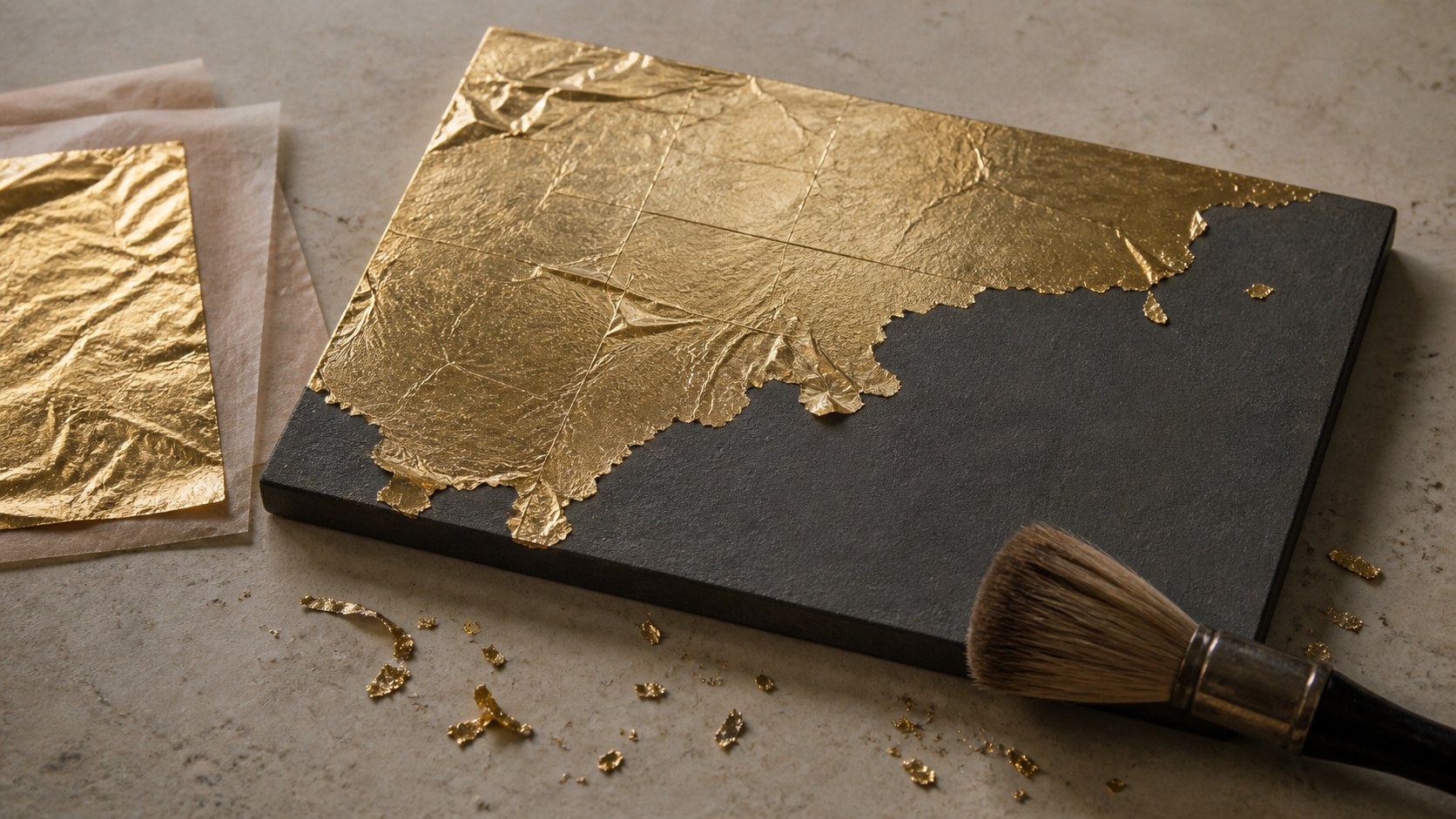
Two gold-coloured samples can look similar under soft studio light and behave very differently beside a retail spotlight. One reflects as a continuous coating; the other reveals delicate leaf edges, small creases and shifts in direction. Those differences are part of the construction, not just the colour selection.
Gilded wall panel manufacturing brings a thin metal leaf onto a prepared surface through an adhesive system and controlled finishing. For an interior designer, the important questions are which metal is used, how the underlying surface shapes reflection, and what the completed protective system looks like. The sequence below describes general process principles, not a claim that every Versa finish uses the same materials or method.
At a glance
A gilded wall finish is a layered construction: prepared substrate, any ground or decorative base, gilding adhesive, metal leaf and a protective finish where required. Each layer can change the final appearance. Approve the complete finished sample, including its edges and expected variation.
- Identify the leaf material; “gold” may describe colour rather than genuine gold content.
- Separate traditional water gilding from modern water-based adhesive systems.
- Review sheen and leaf pattern under project lighting, after any specified protective treatment.
What is beneath the metal leaf?
The panel body provides shape and support. Surface preparation establishes the plane and texture on which the leaf will sit. A deliberately textured ground can create a broken reflection, while a smoother preparation can produce a more continuous one. Neither effect should be inferred solely from a flat colour swatch.
Metal leaf is extremely thin and follows the prepared surface rather than hiding its irregularities. A grain of debris or sanding mark can change the direction of reflected light. For a glossy finish, inspect the approved sample obliquely as well as face-on; the reflection can reveal details that are less visible under diffuse lighting.

Ask whether the colour beneath the leaf is intended to remain visible at cracks, overlaps or distressed areas. A warm or dark ground can contribute to the finished effect, but an uncontrolled gap is not automatically an artistic feature. Agree what exposed ground is acceptable through a labelled physical sample.
The finish description should therefore include both the leaf and the prepared base. If the backing panel or texture layer changes during development, check whether the approved reflection and edge treatment still represent the new construction.
How does the leaf attach to the surface?
“Size” is the gilding adhesive. It must be suitable for the chosen leaf, substrate, environment and subsequent finish. The leaf is applied when the adhesive is in the working condition specified by its manufacturer; that condition is not a universal number of minutes.
Gold Leaf Supplies' overview of gilding sizes distinguishes oil-based, water-based and specialist systems. It also identifies exceptions to simple interior/exterior rules. That is why specifying “water-based size” alone is insufficient: the actual product and approved application are needed.

Do not confuse a modern water-based adhesive with traditional water gilding. Traditional water gilding is a particular preparation and application route associated with a suitable ground and bole; it is not simply any method that uses water. Likewise, burnishing is not a finishing instruction that can be applied indiscriminately to every leaf-and-adhesive system.
For design approval, ask the supplier to identify the proposed process at the level relevant to the finished panel: ground, leaf, adhesive family, intended texture and protective system. Process time, application settings and curing conditions should follow the qualified product instructions, not an improvised project specification.
Leaf placement creates a visible pattern
Leaf sheets may leave overlaps, small wrinkles and directional changes. A transfer leaf is carried on a backing sheet during placement, while loose leaf is handled without that carrier. Gold Leaf Supplies describes these formats and the transfer process. The choice affects handling, but neither format by itself defines the entire aesthetic.
Ask to see enough finished area to understand the leaf rhythm. If a sample contains only a small central patch, it may exclude the junctions and repeated placement pattern that become visible on a full panel. Decide whether those marks should be prominent, subdued or intentionally irregular.
Which metal and protective finish are being approved?
Genuine gold leaf, imitation gold-coloured leaf, silver leaf and copper leaf are different materials. Their names should not be interchangeable in a schedule. Request the specific leaf identity and any relevant composition information from the supplier rather than describing all warm metallic finishes as gold leaf.
For example, Gold Leaf Supplies identifies its imitation gold leaf as a brass alloy and advises protective coating against tarnishing. This supports an important distinction between appearance and material identity. It does not establish the composition or durability of an unidentified wall-panel SKU.

A clear protective finish is also part of the visual result. It can change sheen, depth and the way the leaf catches the light. Review the completed system after the required curing stage, rather than approving an unfinished leaf surface and adding a topcoat later without another review.
Ask what protection is intended for the actual location. A high-touch circulation zone, a protected upper wall and an area cleaned frequently are different use conditions. Obtain care instructions for the complete finish and discuss how the owner will clean it. Do not assume that metal appearance means resistance to abrasion, solvents or moisture.
If a distressed or patinated effect is desired, distinguish an applied decorative treatment from ongoing chemical change. Record the intended visual endpoint, approved variation and protection. This avoids describing a stable imitation patina and a reactive metal finish as though they have the same maintenance behaviour.
How can a designer control hand-finished variation?
Approve a range, not just a favourite fragment. Use a central reference plus examples showing the acceptable limits of leaf visibility, contrast, sheen and exposed ground. Review those references under the intended lighting direction and keep panel orientation consistent during comparison.
| Variable | Approval question | Record to retain |
|---|---|---|
| Leaf identity | What metal or alloy is being supplied? | Supplier material description |
| Ground | Smooth, textured or intentionally exposed? | Prepared/finished reference relationship |
| Leaf pattern | How visible are overlaps and wrinkles? | Representative finished area |
| Colour effect | Is the tone from leaf, ground or treatment? | Finish reference and revision |
| Protective system | What changes after coating and curing? | Complete finished approval sample |
| Panel edges | How do cuts, returns and joints finish? | Edge and adjacent-panel detail |
| Variation | Which differences are acceptable? | Labelled range samples |
| Maintenance | How are cleaning and damage handled? | Written care and repair guidance |

For a large feature wall, review neighbouring panels together. A subtle shift in sheen can become a strong band when a spotlight grazes the surface. Decide how panels are sequenced and whether the installer may rotate them. Keep a record of the accepted arrangement where continuity matters.
Discuss repair before installation. Local touch-up may remain visible because the surrounding leaf pattern and finish have aged or reflect differently. Ask whether the intended response is local repair, refinishing a bounded area or replacing a complete panel. A spare piece is useful only if the removal detail and replacement scope are also understood.
Questions designers often ask
Is gilding the same as metallic paint?
No. Gilding applies metal leaf; metallic paint distributes reflective material within a coating. Both can create useful effects, but the material construction and surface rhythm differ. Specify the intended method rather than relying on a colour name.
Can every gilded finish be highly polished?
No. The available sheen depends on the ground, leaf, adhesive method and protective system. Request an achievable physical sample. Do not add a burnishing requirement without confirmation that it belongs to the selected process.
Should all gilded panels receive a clear coat?
Not as a universal rule. The need and suitable product depend on the leaf, use conditions and complete system. What matters for approval is that the sample includes the protection actually proposed for the project.
Review the finish in the light it will live in
Send the desired tone, reference image, lighting direction and expected contact or cleaning conditions. Explore Art Gilded Panels and discuss a finished sample, including a panel edge and acceptable variation. For a commercial feature wall, pair the finish review with our retail wall design guide.
Considering this surface for your project?
Discuss leaf identity, sheen, finish variation and a protected sample for your wall.
Discuss Your Project Request Samples